Top 5 KYB Software Providers for Seamless Vendor Onboarding in 2026

Why KYB Software Matters
How do you avoid onboarding entities involved in fraud, money laundering, or sanctions violations? The answer is simple, by using Know Your Business or KYB software providers that confirms who you’re doing business with, move funds, or sign contracts.
The KYB market has moved beyond basic entity lookups. Nowadays, organizations need more from their KYB software providers. They want a platform that verifies legal entities, map beneficial ownership, screen sanctions, and validate tax identifiers in a single workflow. Using multiple disconnected tools or manual processes result in delays, data inconsistencies and compliance gaps.
Top 5 KYB Software Providers
Selecting the right provider requires evaluating jurisdictional coverage, API performance, platform architecture, and alignment with your organization’s risk profile and volume requirements.
Here are the top 5 KYB software for business verification for 2026.
1. Compliancely (Unified Business Verification Platform)
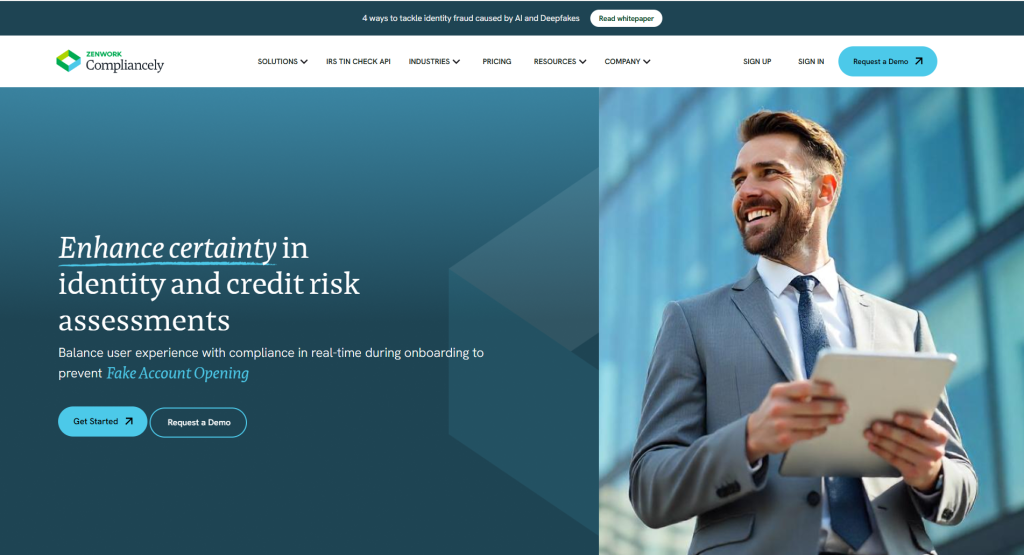
Compliancely is a 360-degree business identity and tax verification platform, that lets you onboard entities and businesses with a complete picture of their risk profile. It is designed to serve banks, fintechs, marketplaces, and enterprises that require KYB, KYC, sanctions screening, and TIN/EIN checks in a single workflow.
Core Capabilities
- Real-time verification combining business entity status, beneficial ownership mapping, and TIN/EIN validation in one workflow.
- Integrated sanctions, watchlist, PEP screening, and continuous monitoring for entities and individuals.
- Provides high-volume APIs and plug & play widgets to easily integrate into your existing workflows and automate KYB processes.
- Maintain unified audit logs for every KYB event, decision, and override.
- Built with enterprise grade security to ensure your data is processed securely.
- Part of Zenwork’s broader tax and compliance infrastructure.
| Pros | Cons |
|---|---|
| Unified platform for KYB, KYC, sanctions, address, and tax ID verification | Optimized for organizations ready to integrate its API into their existing onboarding journeys |
| Supports high-volume, real-time onboarding of customers, vendors, and partners | Robust features may exceed the requirements of very small, low-risk programs |
| Configurable decision rules that reduce manual review volume and verification errors | |
| Reduces vendor dependencies while improving audit preparedness |
Pricing: Contact the Compliancely team for a custom quote
2. Trulioo (Global KYB and Identity Data Platform)

Trulioo offers comprehensive global KYB and KYC capabilities. This platform targets organizations that require seamless onboarding of businesses and individuals across countries and regulatory environments.
Core Capabilities
- Unifies business and individual verification in a single, integrated workflow to streamline onboarding.
- Provides access to diverse sources such as government registries, credit bureaus and proprietary information across countries.
- Workflow enables you to tailor KYC, KYB and AML verification by region while maintaining audit readiness.
- Utilizes AI/NLP capabilities to ensure data standardization and translation across vast global sources.
| Pros | Cons |
|---|---|
| Strong data coverage for cross-border business onboarding and risk checks | Implementation and fine-tuning complex workflows can be challenging for smaller or less technical teams |
| Adaptable workflows for different regulatory jurisdictions | Specialized tax reporting workflows may require additional external vendors |
Pricing: Contact the Trulioo team for a custom quote
3. Sumsub (KYB, KYC, and Fraud Suite)

Sumsub offers KYB, KYC, and fraud prevention in a unified platform for digital-first businesses including fintechs and marketplaces.
Core Capabilities
- Automated KYB using registry data, documents, and ownership structures.
- Risk-based rules that combine KYB, KYC, and fraud signals in one flow.
- Configure verification workflows with jurisdiction-specific check sequences and automated decision rules.
| Pros | Cons |
|---|---|
| Unified approach for teams requiring onboarding and fraud tools | Requires ongoing configuration and monitoring by compliance and product teams |
| Configurable workflows aligned to internal risk policies | TIN and tax reporting typically needs separate solutions |
| May be more complex than other KYB programs |
Pricing: Sumsub uses a tiered pricing system, depending on your needs.
- Basic: $1.35 per verification
- Compliance: $1.85 per verification
- Enterprise: Custom quote
4. Middesk (U.S-Focused Business Verification)
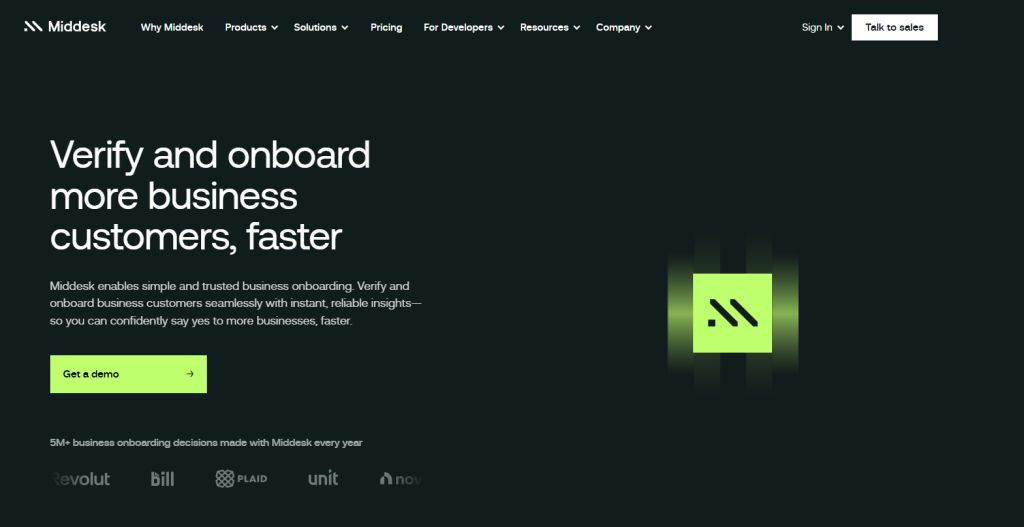
Middesk is a U.S.-centric KYB provider for banks, fintechs, and B2B platforms that primarily engage with domestic entities. It automates business identity verification by retrieving KYB data directly from U.S. Secretary of State offices and the IRS.
Core Capabilities
- Provides API access to U.S. business registration status, officer information, and data necessary for onboarding, underwriting, and risk modeling.
- Pull registry data directly from Secretary of State (SoS) filings across U.S. states.
- Workflows to fetch documents such as Articles of Incorporation and Certificate of Good Standing associated with a business.
| Pros | Cons |
|---|---|
| Specialized for U.S-only KYB requirements, offering high domestic accuracy and speed | Limited international capabilities for global programs |
| Clear developer experience for teams building custom workflows | Teams may require additional vendors for non-U.S. sanctions coverage or broader tax reporting |
Pricing: Custom pricing plans starting at $500 per month.
5. LexisNexis Risk Solutions (Enterprise KYB & Risk Data)

LexisNexis Risk Solutions offers extensive business, ownership, and risk data that can support KYB and broader third-party risk management. This platform is mainly utilized by heavily regulated institutions that require extensive data.
Core Capabilities
- Entity, ownership, adverse media, and sanctions screening data at scale.
- Supports both batch and ongoing monitoring for risks from global watchlists, sanctions, PEPs, and media sources.
- Configurable screening tools and sophisticated case management required by top-tier financial organizations.
| Pros | Cons |
|---|---|
| Superior data depth, which is indispensable for institutions in complex or high-risk sectors | Can be resource-intensive to deploy and maintain for smaller teams |
| Useful for large enterprises seeking to embed KYB components into wider third-party risk programs | Often used alongside separate systems for tax reporting and, in some cases, specialized address validation |
| May be excessive if the primary need is onboarding and standard KYB |
Pricing: Contact the LexisNexis team for a custom quote.
How to Select the Right KYB Provider
Selecting the right business identity and sanctions screening software depends on your exact needs.
- Define your requirements: Identify where KYB is mandatory, which jurisdictions you operate in, and whether you need entity verification alone or a full stack including KYC, sanctions, TIN checks, and address checks.
- Assess volume and performance needs: Calculate daily and peak verification volumes, target decision times, and acceptable manual review rates. Choose providers with proven API performance and consistent match quality.
- Compare platform strategy and cost: Evaluate a unified platform versus multiple point solutions, factor in licensing, maintenance, engineering resources, and the risk of data inconsistency across systems.
- Run a pilot with real cases: Test actual customer, vendor, and high-risk entity scenarios to measure accuracy, manual review rates, decision speed, and audit readiness across providers.
FAQs
1. What does KYB software verify?
KYB software validates legal entities, ownership and control structures, registration status, and risk indicators such as sanctions or adverse media. This allows you to assess whether and how to engage with a business.
2. Can I combine KYB, KYC, and tax ID checks in one platform?
Some platforms like Compliancely consolidate KYB, KYC, sanctions, address verification, and TIN/EIN checks into a single workflow rather than distributing them across multiple vendors.
3. Is KYB only required for financial institutions?
While financial institutions face strict regulations, many B2B platforms, marketplaces, and enterprises also use KYB to reduce fraud, credit risk, and reputational exposure when onboarding business partners.
4. How do KYB providers charge for their services?
Most vendors use usage-based or tiered pricing based on check volume, data depth, and add-ons such as continuous monitoring. Accurate budgeting requires clarity on your expected volumes.
Ready to upgrade your KYB process?
Compliancely automates your business verification, ownership checks, and sanctions screening, all in one platform.